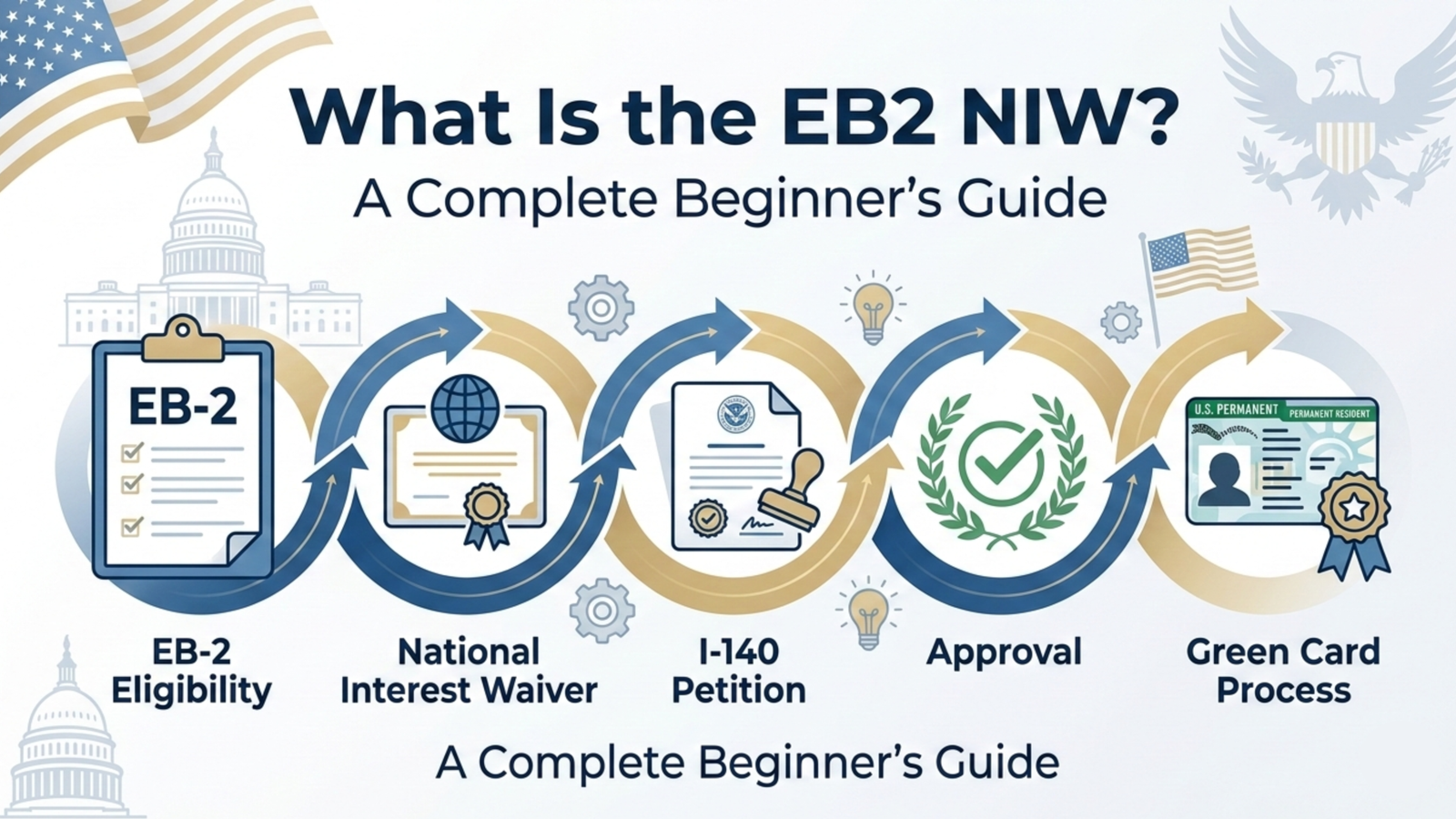
EB 2 NIW visa can be one of the best green card options for professionals with a strong academic or career background whose work can benefit the United States beyond a single employer. Unlike many employment-based paths, the EB 2 NIW visa may allow eligible applicants to move forward without a job offer. However, many people misunderstand the standard. USCIS does not approve an NIW case just because someone is well educated, accomplished, or talented. An applicant must first qualify for the underlying EB-2 category and then show that waiving the usual job-offer and labor-certification requirements is in the national interest under the Matter of Dhanasar framework.
In simple terms, a strong EB 2 NIW visa case usually includes three things: a credible professional foundation, a clearly defined proposed endeavor, and evidence showing that the endeavor has meaningful value for the United States. The strongest cases are not built on hype or broad claims. They are built on a focused evidence strategy that connects each document to a specific legal requirement. That is what this page should help readers understand from the start.
Quick answer: who usually qualifies?
A person is typically a serious EB 2 NIW visa candidate if they can show both of these points:
- They qualify for EB 2 NIW as either:
- a professional with an advanced degree, or
- a person of exceptional ability in the sciences, arts, or business; and
- They satisfy the three NIW factors from Matter of Dhanasar:
- the proposed endeavor has substantial merit and national importance,
- they are well positioned to advance it, and
- on balance, it benefits the United States to waive the normal job-offer and labor-certification requirements.
That means the right applicant is often not “the most famous person in the field.” It is the person whose case is easiest to understand on paper: what they do, why it matters, what they have already achieved, and why the U.S. benefits from letting them move forward without the usual employer-led PERM route.
What the EB 2 NIW actually waives
Under the normal EB 2 NIW visa process, a U.S. employer generally files Form I-140 and the case usually requires a labor certification. With a national interest waiver, the applicant can ask USCIS to waive the job-offer and labor-certification requirements and may self-petition by filing Form I-140 with national-interest evidence. USCIS also makes clear that applicants must first qualify for the underlying EB 2 classification before the NIW analysis even begins.
That distinction matters. A surprising number of weak cases focus only on the applicant’s importance and ignore the threshold EB-2 NIW visa requirement. If the reader does not qualify as either an advanced-degree professional or a person of exceptional ability, the NIW argument never gets off the ground.
Step 1: You must qualify for EB 2 first
Option A: Advanced degree professional
The clearest EB 2 route is the advanced degree path. USCIS and the Department of State describe this as either:
- a degree above a bachelor’s, or
- a bachelor’s degree plus at least five years of progressive post-baccalaureate experience in the profession.
For many applicants, this is the cleaner route because it is easier to prove with transcripts, diplomas, and employer letters. If someone has a master’s degree, PhD, MD, or a bachelor’s plus strong progressive experience, this path is usually simpler than trying to build an “exceptional ability” case.
Option B: Exceptional ability
If the applicant does not fit the advanced-degree route, they may still qualify through exceptional ability. USCIS says exceptional ability means a degree of expertise significantly above that ordinarily encountered in the sciences, arts, or business. The initial evidence must include at least three of the regulatory evidence types, such as an academic record, 10 years of experience, a license or certification, salary evidence, professional memberships, or recognition for achievements. But USCIS also says that merely checking three boxes is not enough: officers still conduct a final merits determination and assess the overall quality of the evidence.
This is where many self-filers underestimate the standard. A stack of documents is not the same as a persuasive case. The documents must actually show uncommon expertise, not just ordinary career progression.
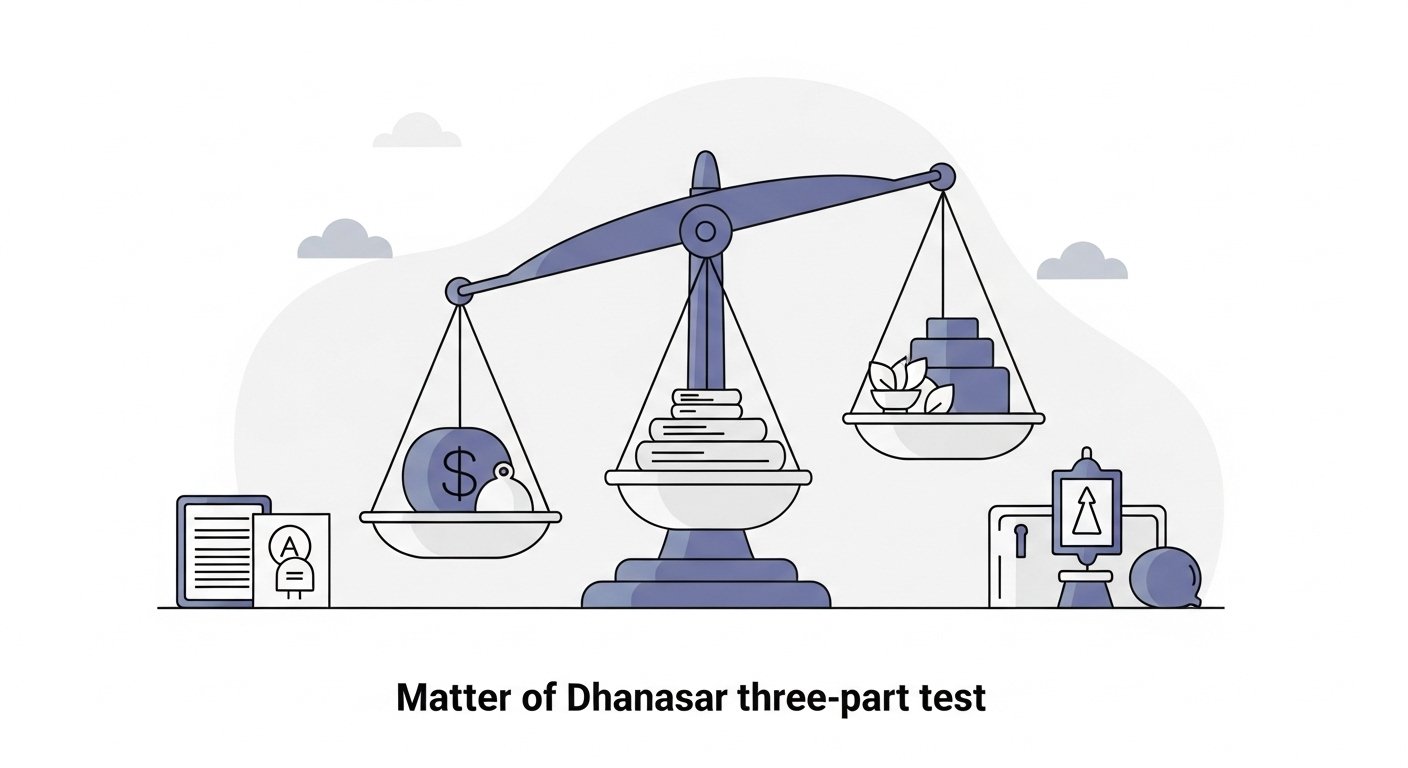
Step 2: You must pass the Dhanasar three-part test
1. Your proposed endeavor must have substantial merit and national importance
This first prong focuses on the specific endeavor the applicant plans to undertake, not just the prestige of their profession. USCIS and AAO decisions explain that merit can exist across business, entrepreneurialism, science, technology, culture, health, and education, while national importance turns on the endeavor’s potential prospective impact and broader significance. USCIS also warns that broad claims about entrepreneurship, economic growth, or job creation alone are not enough.
That is why “I am a software engineer” is too vague, but “I develop cybersecurity systems for critical financial infrastructure” is a real starting point. Likewise, “I own a business” is weak, while “I am building a company that improves grid resilience for utilities” is far more concrete.
Strong example:
A civil engineer whose work focuses on flood mitigation, resilient infrastructure, and public-risk reduction can often explain national importance more clearly than someone who simply says they work in construction.
Weak example:
A founder who says their startup will “create jobs and help the economy” but has no defined product, traction, contracts, or policy relevance will usually struggle on this prong.
2. You must be well positioned to advance the endeavor
The second prong is about execution. USCIS looks at whether the person is actually positioned to carry the work forward, not whether success is guaranteed. Recent USCIS guidance specifically discusses how officers may evaluate STEM professionals and entrepreneurs, and notes the potential value of evidence such as letters from governmental or quasi-governmental entities, records of achievement, and other proof that the person’s work is credible and needed.
In practical terms, strong evidence here often includes:
- publications, citations, patents, or peer review,
- awards or media coverage,
- funded research,
- letters from independent experts,
- contracts, pilots, grants, user traction, or revenue,
- leadership in important projects,
- a clear future plan tied to past results.
A reader should understand this point clearly: USCIS is not asking whether you are promising. It is asking whether the record already shows momentum.
3. On balance, waiving the job offer and labor certification must benefit the United States
The final prong is the part applicants often explain poorly. The question is not simply whether the applicant is talented. The question is why the United States should let this person move forward without the normal employer-driven process. Under Matter of Dhanasar, USCIS may approve the waiver when, on balance, it would benefit the United States to waive the job-offer and labor-certification requirements.
A strong argument here might look like this:
- the applicant’s work is too specialized or entrepreneurial for a normal PERM process,
- their impact extends beyond one employer,
- the national benefit of the work is broader than a single job opening,
- the person is likely to contribute in ways the standard labor-certification model does not capture well.
This is why founders, researchers, deep-tech specialists, physicians in qualifying NIW contexts, and highly specialized professionals can sometimes be better NIW candidates than strong but ordinary employees.
Real-world profiles that often fit the EB 2 NIW well
Researcher or scientist
A PhD researcher with peer-reviewed publications, citation history, conference presentations, peer review work, and recommendation letters from independent experts may be a strong NIW candidate if their research clearly addresses a U.S. need such as public health, energy, AI, semiconductors, or advanced manufacturing. USCIS has also issued specific guidance relevant to STEM-related NIW cases or more specific, the EB 2 NIW case.
Entrepreneur or founder
An entrepreneur can qualify, but USCIS is explicit that not every entrepreneur qualifies and that vague claims about jobs or the economy are insufficient. Strong founder cases usually need a defined business model, evidence of traction, credible market demand, contracts, letters of intent, customer adoption, grant support, or other independent proof that the endeavor is real and nationally meaningful.
Advanced technical professional
An engineer, cybersecurity professional, data scientist, or product specialist may qualify if the case moves beyond the job title and shows a specific national-impact endeavor. The law does not reward general competence. It rewards a well-documented case tied to broader U.S. benefit.

Who usually does not qualify yet
Not every impressive resume is NIW-ready. A case is often weak when:
- the applicant has a good career but no clear proposed endeavor,
- the work sounds useful but not nationally important,
- the evidence is mostly self-written claims,
- the letters are generic and repetitive,
- the applicant can describe past work but cannot explain future U.S. impact,
- the file proves credentials but not momentum.
One of the biggest mistakes is presenting the profession as important instead of the endeavor as important. USCIS decisions repeatedly focus on the specific proposed endeavor and its prospective impact, not the general prestige of the field.
Evidence that makes an NIW case stronger
A strong EB 2 NIW visa case usually includes evidence mapped to each legal prong, not just gathered randomly. Depending on the profile, that may include:

For EB 2 threshold eligibility
- diplomas and transcripts,
- credential evaluations for foreign degrees where needed,
- employer letters proving progressive experience,
- exceptional-ability evidence that matches the regulations.
For national importance
- a tightly written proposed endeavor statement,
- industry reports,
- policy references,
- market need evidence,
- proof that the work affects a broader U.S. interest.
For being well positioned
- publications, patents, citations, grants,
- major project records,
- expert recommendation letters,
- contracts, pilots, user growth, or implementation proof,
- media or institutional recognition.
For the “on balance” prong
- evidence that the endeavor is not easily captured by a standard PERM case,
- proof of broader public benefit,
- documentation showing why the applicant’s contribution should not be limited to one sponsoring employer.
Expert tip: In strong NIW files, every major exhibit should answer one question:
“Which exact legal prong does this document help prove?”
That one discipline alone usually improves case clarity.
Practical filing point most pages miss
Current USCIS guidance for NIW filings includes a technical filing detail many older articles miss: national interest waiver petitions must be accompanied by a completed Form ETA-9089, Appendix A, and a signed Form ETA-9089 Final Determination. USCIS policy guidance also explains the post-June 1, 2023 FLAG-era handling of ETA-9089 documents.
That is exactly why readers should avoid relying on outdated blog posts. NIW law evolves slowly, but filing mechanics and policy guidance do change.
Should you pursue EB 2 NIW, EB-1A, or regular employer-sponsored EB 2?
This is where good guidance becomes commercially valuable.
- Choose EB 2 NIW visa if you have a strong professional record, your work serves a broader U.S. interest, and you want flexibility without depending on one employer.
- Choose EB-1A if your record is closer to top-of-field acclaim and you may qualify for the higher extraordinary-ability standard.
- Choose employer-sponsored EB 2 NIW visa if you have a stable sponsoring employer and your case is stronger as a traditional PERM-based filing than as a national-interest case. USCIS and DOS both distinguish these tracks clearly.
For many serious applicants, the smartest answer is not “Which category is best?” but “Which category is easiest to prove with the evidence I already have or can realistically build in the next 3 to 6 months?”
Common objections — answered honestly
“I don’t have major awards. Am I disqualified?”
Not necessarily. Awards help, but NIW is not limited to award winners. Many strong cases are won through a combination of education, experience, independent recognition, implementation record, and a well-defined endeavor rather than one headline credential. USCIS evaluates the totality of the evidence.
“I live outside the U.S. Can I still apply?”
Yes. Employment-based immigrant visas are available to qualified applicants abroad as well, and NIW is part of the employment-based immigrant system. After petition approval, applicants abroad typically continue through consular processing when visa numbers are available.
“Can my spouse and children benefit too?”
Employment-based immigrant visas can include certain derivative benefits for spouses and qualifying children. The Department of State notes that certain spouses and children may accompany or follow to join employment-based immigrants.
About timing and next steps
Employment-based immigrant visas are numerically limited, the filing date becomes the priority date, and some applicants may wait for visa availability depending on category demand and country of chargeability. Premium processing is available for certain filings through Form I-907, but USCIS has also updated premium-processing fees effective March 1, 2026, so readers should always verify the current fee schedule and instructions before filing.
That is why the best next step is not rushing to file. It is doing a serious eligibility review first: identify the cleanest EB-2 route, define the endeavor properly, pressure-test the Dhanasar prongs, and fix evidence gaps before Form I-140 is prepared.
Why readers choose a premium NIW consultancy
A strong visa consultancy service should not just “collect documents.” It should build a legal narrative. The best USP for this page is:
Strategy-first NIW case building with evidence mapping
Instead of giving clients a generic checklist, the service maps each document to:
- EB 2 threshold eligibility,
- national importance,
- well-positioned evidence,
- and the final “on balance” waiver argument.
That reduces weak filings, improves clarity, and gives applicants an honest answer early if the case is not ready yet.
Clear call to action
If you are unsure whether your profile fits the EB 2 NIW visa, do not start with forms. Start with a prong-by-prong eligibility assessment. A serious review should tell you:
- whether you qualify through advanced degree or exceptional ability,
- whether your proposed endeavor is framed correctly,
- what evidence is already strong,
- what is missing,
- and whether NIW, EB-1A, or employer-sponsored EB 2 is the better path.
Book a premium EB 2 NIW visa eligibility review and get a realistic case strategy before you file.
FAQ
1) Do I need a job offer for an EB 2 NIW visa?
The whole point of the NIW is that USCIS may waive the normal job-offer and labor-certification requirements when the national-interest standard is met.
Do I need a master’s degree?
Not always. You may qualify with a degree above a bachelor’s, or with a bachelor’s degree plus at least five years of progressive post-baccalaureate experience.
Is exceptional ability the same as extraordinary ability?
Exceptional ability is the EB 2 standard; extraordinary ability is associated with EB-1A and is generally a higher standard.
Are entrepreneurs eligible for NIW?
Yes, but not automatically. USCIS has specific guidance for entrepreneurs and also warns that broad claims about economic benefit or job creation alone are not enough.
Can I apply from outside the United States?
Usually, it is failing to define the proposed endeavor clearly enough. USCIS looks at the specific endeavor and its prospective national impact, not just a prestigious job title.