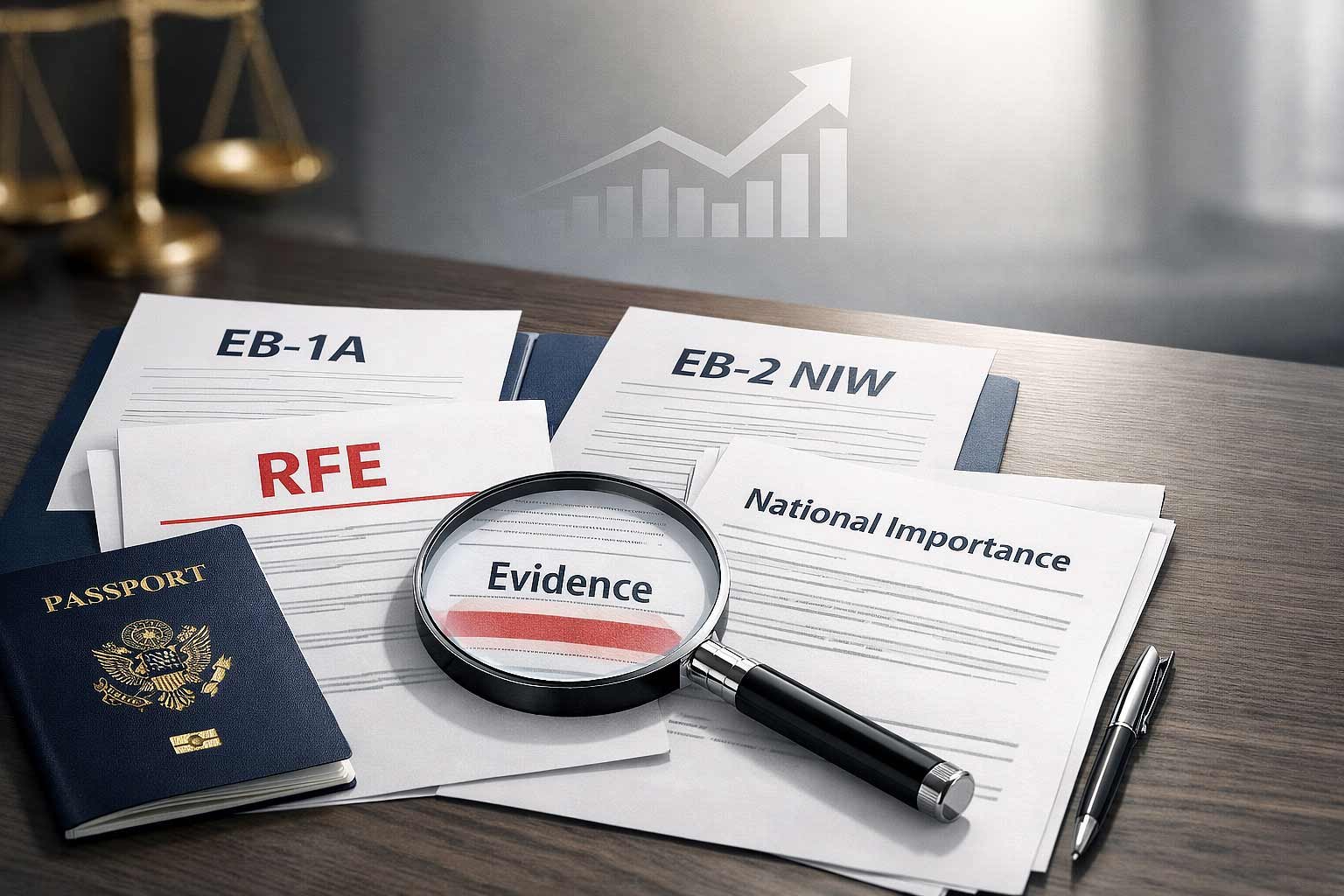
An RFE Is Not Random — It’s Diagnostic
A Request for Evidence (RFE) is one of the most stressful moments in the immigration journey.
Applicants often ask:
- Why did I get an RFE if I meet the criteria?
- Did the officer misunderstand my evidence?
- Is an RFE a sign of denial?
In most cases, an RFE is not random. It is diagnostic.
It means the adjudicating officer found that the documentation submitted did not clearly meet immigration evidence standards. It signals uncertainty — not necessarily rejection.
An RFE typically arises when:
- Evidence is insufficient
- Documentation lacks clarity
- Claims exceed proof
- Independent recognition is weak
- National importance is poorly articulated
RFEs are rarely about lack of achievement.
They are about lack of structured presentation.
How Immigration Officers Evaluate Evidence in 2026
Understanding adjudication psychology is critical to avoiding RFEs.
Immigration officers reviewing EB-1A, EB-2 NIW, UK Global Talent, and National Innovation Visa cases evaluate:
- Credibility of documentation
- Independent validation
- Logical consistency
- Relevance to statutory criteria
- Measurable impact
- Future national contribution
Officers are trained to identify overstatements, inconsistencies, and unsupported claims.
They do not assume excellence. They require proof.
The Most Common Evidence Mistakes That Trigger RFEs
Below are the most frequent immigration evidence mistakes seen in 2026 filings.
Presenting Job Duties as Extraordinary Achievement
One of the top EB-1A RFE reasons is confusing employment responsibility with exceptional accomplishment.
Statements such as:
- “I led a project.”
- “I managed a department.”
- “I was responsible for innovation.”
- “My role was critical.”
do not automatically demonstrate extraordinary ability or national importance.
Officers evaluate outcomes, not responsibilities.
Strong evidence must show:
- Quantifiable results
- Innovation beyond routine tasks
- Industry-level influence
- Measurable impact
Without documented outcomes, officers often issue RFEs requesting clarification.
Weak or Generic Recommendation Letters
Recommendation letters are frequently misunderstood.
Common mistakes include:
- Letters that repeat the résumé
- Exaggerated praise without examples
- Lack of national importance explanation
- Letters only from internal supervisors
- No independent expert validation
Officers are experienced in detecting generic language.
A strong letter should:
- Provide concrete examples of contribution
- Explain broader industry or national impact
- Establish the writer’s credibility
- Demonstrate independent recognition
Letters must validate impact — not merely describe character.
Failing to Prove National Importance Clearly
A major EB-2 NIW RFE trigger is weak explanation of national importance.
Applicants often assume that working in AI, healthcare, renewable energy, or cybersecurity is sufficient. It is not.
Officers require evidence showing:
- Broader implications beyond one employer
- Alignment with national development priorities
- Sector-level influence
- Scalable impact
If national importance is implied rather than documented, scrutiny increases.
Disorganized or Unstructured Documentation
Immigration officers do not reorganize petitions for applicants.
Common structural mistakes include:
- Submitting hundreds of pages without indexing
- Providing duplicate evidence
- Failing to tie documents to specific criteria
- Mixing irrelevant materials
Disorganization creates confusion.
Strong cases follow evidence architecture:
- Each criterion is clearly labeled
- Each claim is supported by specific documentation
- Clear summaries before evidence
- Logical narrative progression
Clarity prevents RFEs.
Overreliance on Employer Reputation
Working at a prestigious company does not automatically prove extraordinary ability.
Many professionals assume that employer prestige compensates for weak personal evidence.
Officers evaluate:
- Individual contribution
- Measurable outcomes
- Independent validation
Corporate reputation provides context — not qualification.
Low-Quality Publications or Questionable Journals
In 2026, officers are increasingly aware of predatory journals and pay-to-publish platforms.
Red flags include:
- Journals with no peer review
- Articles unrelated to expertise
- Self-published materials presented as scholarly
- Mass-produced opinion content
Publication quality matters more than volume.
Weak publication strategy frequently triggers EB-1A RFEs.
Lack of Independent Recognition
Independent recognition is central to merit-based immigration.
If all documentation comes from:
- Internal company records
- Direct supervisors
- Self-authored descriptions
Officers may question credibility.
Independent recognition may include:
- Awards
- Judging roles
- Citations
- Media coverage
- Conference invitations
- Industry adoption
Without third-party validation, cases often receive RFEs.
Inflated or Unverifiable Claims
Overstatement is one of the fastest ways to trigger scrutiny.
Claims such as:
- “I am a global leader.”
- “My work revolutionized the industry.”
- “My contributions are unmatched.”
must be supported by objective documentation.
If exaggeration exceeds proof, officers may question overall credibility.
Strong cases understate and over-document.
Weak Proposed Endeavor in EB-2 NIW Cases
In NIW filings, the proposed endeavor is crucial.
Common mistakes include:
- Vague future plans
- Generic career descriptions
- No alignment with national priorities
- No measurable projected impact
Officers must understand:
- What you intend to do
- How it benefits the nation
- Why you are uniquely positioned
If future contribution is unclear, RFEs often follow.
Filing Before Profile Maturity
Premature filing is a silent RFE trigger.
Signs include:
- Limited independent recognition
- Minimal measurable outcomes
- Weak evidence architecture
- Inconsistent narrative
Immigration readiness is not about meeting minimum criteria. It is about presenting a defensible case.
High-Risk Areas That Often Trigger RFEs
Certain areas consistently generate additional scrutiny:
- Media coverage lacking credibility
- Awards without selection transparency
- Judging roles without verification
- Patents without evidence of use
- Publications without citations or impact
Officers evaluate substance over appearance.
How to Avoid RFE in EB-1A and EB-2 NIW
Prevention is more effective than response.
A strong documentation strategy includes:
- Comprehensive immigration profile assessment
- Structured evidence architecture
- Independent validation alignment
- Clear quantification of impact
- Profession-specific positioning
- Logical petition drafting
Strategic preparation significantly reduces RFE risk.
How to Respond to Immigration RFE Properly
If you receive an RFE, respond strategically.
Effective RFE response strategy includes:
- Careful review of officer concerns
- Direct and structured rebuttal
- Additional supporting evidence
- Clear explanation tied to statutory criteria
- Organized submission format
Emotional or defensive responses weaken credibility.
An RFE response must be analytical and precise.
The 2026 Trend: Increased Scrutiny, Higher Standards
Immigration adjudication standards continue to evolve.
Officers increasingly prioritize:
- Independent recognition
- Verifiable documentation
- Clear national importance
- Logical structuring
- Authentic contributions
Superficial visibility and inflated narratives are easier than ever to detect.
Quality of evidence matters more than quantity.
RFEs Are Often Preventable
Most RFEs are not caused by lack of qualification.
They result from:
- Weak framing
- Incomplete documentation
- Disorganized evidence
- Overstatement
- Filing too early
When cases are structured properly, many RFEs can be avoided entirely.
If you are preparing for EB-1A, EB-2 NIW, UK Global Talent, or Australia’s National Innovation Visa — or if you have received an RFE and need clarity — begin with a structured immigration profile assessment before proceeding. Immigration success is rarely about luck.
It is about defensibility.