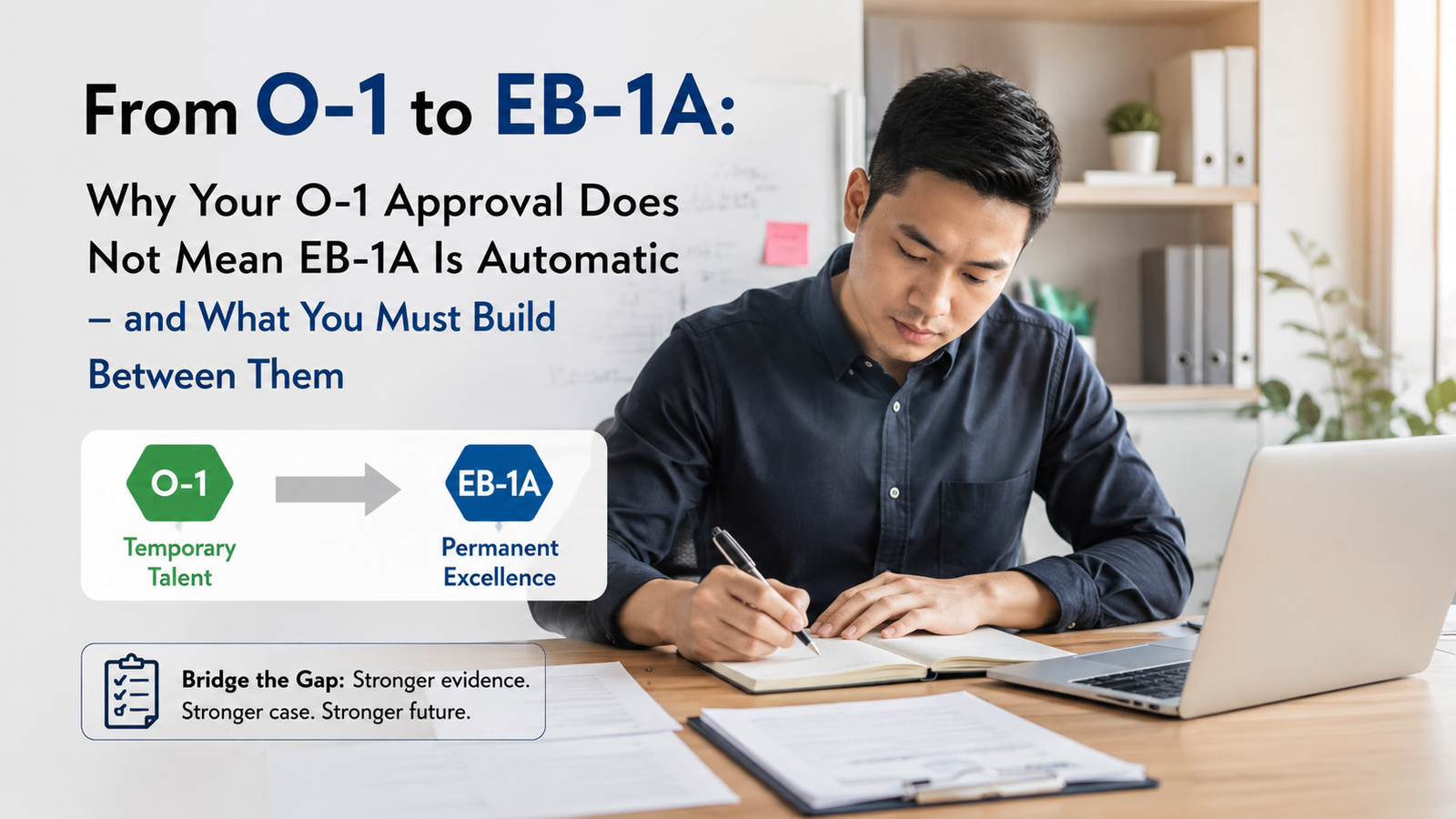
Before You File Green Card Application: How Profile Building Differs From Traditional Immigration Consulting
Most immigration firms offer the same service for green card application: take your existing credentials, write the best possible petition around them, and file. If the credentials are strong, the petition gets approved.
If they are borderline, the petition gets an RFE or a denial. The attorney in both cases did their job. The outcome was determined before the first consultation, by the state of the professional’s evidence architecture at the time of filing.
AdvanceMyProfile starts from a different premise: the evidence architecture is buildable.
Denials are not talent gaps. They are profile gaps. And profile gaps can be closed systematically, deliberately, and in 12 to 24 months before any petition is filed.
This article is the brand story for AdvanceMyProfile. It is simultaneously a practical explanation of what profile building means, why it matters, and how it differs from traditional immigration consultation and an honest account of how the platform works and what it is not.
The Core Diagnosis: Why 35.7 Percent of NIW Petitions Were Denied in Q4 FY2025
In Q4 of FY2025, USCIS denied more EB-2 NIW petitions than it approved a 35.7 percent approval rate that represented the lowest NIW approval rate in recent history. The legal standard did not change. The Dhanasar framework remains the same as it was when it was established in 2016. USCIS’s core requirements have not been raised.
What changed is the practical standard of evidence quality that distinguishes approvable petitions from rejected ones.
Based on analysis of RFE trends and denial patterns by Beyond Border Global (April 2026), Passright (March 2026), and Colombo & Hurd (April 2026), the most common reasons for denial in 2025–2026 are:
• Weak national importance argument describing the field as important without demonstrating that the specific proposed endeavor is nationally important (Prong 1 failure, the most common RFE trigger)
• Generic expert letters that lack specific, verifiable facts corroborated by objective evidence elsewhere in the filing
• Evidence that is genuinely thin not enough independent citations, no competitive grants, no media coverage specifically about the applicant’s work, no documented adoption of the applicant’s original contribution by others in the field
• Missing field-of-expertise alignment between the applicant’s credentials and the proposed endeavor (raised as an explicit issue in the January 2025 USCIS Policy Manual update)
• No documented progression from past work to the proposed US endeavor the ‘bridge’ between what has been done and what will be done is absent
The first and third reasons on this list are not fixable at the petition writing stage. A petitioner whose work has not generated independent citations, has not produced competitive grants, and has not attracted trade press coverage of specific contributions does not have a petition problem. They have a profile problem.
And a petition writer however skilled cannot fix a profile problem by writing better.

What 'Profile Building' Actually Means
Profile building is the systematic process of converting real professional achievement into the specific documented evidence forms that immigration adjudicators can evaluate, credit, and use as the basis for approval.
Real professional achievement and immigration-ready evidence are two different things. A researcher who has done genuinely important work but whose papers have zero independent citations because they have not been published in the venues.
Where the field’s community can find and cite them has a real achievement problem in the immigration sense not because their work is not valuable, but because it is not in the form that the immigration system can evaluate.
| Real Professional Achievement | Immigration-Ready Evidence (What Is Actually Needed) |
|---|---|
| Software engineer who built a widely-used open-source library | Google Scholar profile showing independent citations of the underlying technical paper; GitHub repository with documented third-party adoption metrics; trade press coverage of the library's specific innovations |
| Researcher who has done critical work in drug-resistant tuberculosis | Published papers in indexed journals (not just conference papers) with independent citation counts; NIH or Wellcome Trust grant documentation with competitive award rate; letters from independent TB researchers in different institutions citing specific contributions |
| Business executive who grew revenue from $10M to $150M over 5 years | BLS OES salary benchmark data documenting compensation at or above the 90th percentile; organizational chart showing leading/critical role; scope documentation (P&L size, headcount managed); executive letters addressing specific business outcomes attributable to the applicant's leadership; trade press feature articles about the executive's approach |
| Healthcare leader who implemented a system-wide quality improvement program | Before-and-after metrics with timestamps; publication in a peer-reviewed healthcare journal (if possible); coverage in Modern Healthcare, Health Affairs, or equivalent trade publications; letters from peer institutions' COOs or CMOs describing adoption of the methodology |

Profile building is the 12 to 24-month process of closing the gap between the left column and the right column systematically, with a clear target, and for the specific criteria of the specific petition the professional intends to file.
How AdvanceMyProfile Works and What It Is Not
AdvanceMyProfile is the world’s first end-to-end immigration profile building platform. Powered by Immignis LLC, licensed US immigration attorneys, it is built around the premise that the most valuable intervention in the immigration process happens before the petition is filed, not at the filing stage.
Here is specifically what the platform does:
1. Profile assessment: evaluates the applicant’s current professional record against the specific criteria of EB-1A, EB-2 NIW, UK GTV endorsing body standards, and Australia NIV EOI requirements identifying which criteria are currently satisfied, which are thin, and which are absent
2. Evidence gap analysis: maps the specific documents and evidence types that are missing or insufficient, with a priority ranking based on which gaps have the highest impact on approvability
3. Building program design: constructs a 12 to 24-month evidence building program specific to the applicant’s professional type, field, and target pathways including publication strategy, peer review cultivation, expert letter network development, media coverage approach, and compensation documentation
4. Progress tracking: monitors the building program against the evidence target, identifies when new evidence is generated, and updates the approvability assessment as the portfolio strengthens
5. Filing coordination: when the evidence is genuinely strong, connects the applicant with the appropriate Immignis LLC attorney for petition preparation and filing
What AdvanceMyProfile is not: it is not a petition preparation service for applicants who are already ready to file. It is not a document assembly tool. It is not an alternative to immigration legal advice Immignis LLC attorneys handle all legal work and are responsible for all petition preparation and filing decisions.
The platform is the pre-legal preparation layer: the systematic, deliberate process of building the evidence that makes legal representation most effective.
The Core Insight: Denials Are Profile Gaps, Not Talent Gaps
The EB-1A and EB-2 NIW approval processes evaluate evidence, not talent. A genuinely extraordinary professional whose evidence is thin loses to a less accomplished professional whose evidence is meticulously documented.
This is not a flaw in the system it is a direct consequence of the fact that immigration adjudicators evaluate written records, not the applicants themselves.
The talent is real. The question is whether it is documented correctly. Most professionals who are denied or who receive RFEs on petition evidence are not being told they are not good enough at their work. They are being told that their work, as documented in the petition record, does not meet the specific evidentiary standard that USCIS applies to self-petitions.
That is an evidence architecture problem. It is entirely fixable. But it is not fixable at the filing stage it requires 12 to 24 months of deliberate building before the filing stage arrives.
The AdvanceMyProfile approach exists to fix this problem at the right point in the process: before the petition is filed, while there is still time to build the evidence that makes the petition genuinely strong. Not after a denial, when the options are limited to appeals and refiling. Before.
Start your free profile assessment today
Our free assessment takes 15 minutes and gives you a specific answer to the question that matters most: which self-petition criteria does your current professional record satisfy, which are thin or absent, and what does the 12 to 24-month building program look like for your specific situation?
Not a generic eligibility check. A specific analysis of your evidence against the actual adjudication criteria.
advancemyprofile.com · Free Assessment · Powered by Immignis LLC
What makes AdvanceMyProfile different from working directly with an immigration attorney?
An immigration attorney’s primary role is petition preparation and legal representation they work with the evidence you have at the time of filing. AdvanceMyProfile works in the period before filing: assessing your current evidence, identifying gaps, and managing the building program that closes those gaps before the petition is prepared.
The two are complementary AdvanceMyProfile builds the evidence; Immignis LLC attorneys (who power the platform) prepare and file the petition when the evidence is strong. The combined approach produces substantially better outcomes than filing with whatever evidence happens to exist at the time of consultation.
How long does the profile building process take?
It varies by profile. Professionals who are close to approvable strong on two or three criteria but thin on the others typically complete the building program in 12 to 18 months. Professionals who are starting earlier in their careers or with more significant evidence gaps may take 24 months.
The rate-limiting factor is almost always the independent citation record citations accumulate after indexed publication and take 12 to 24 months to develop into a compelling body of evidence.
Other evidence types (salary benchmarking, compensation documentation, peer review invitations, expert letter cultivation) can often be addressed in 3 to 6 months.